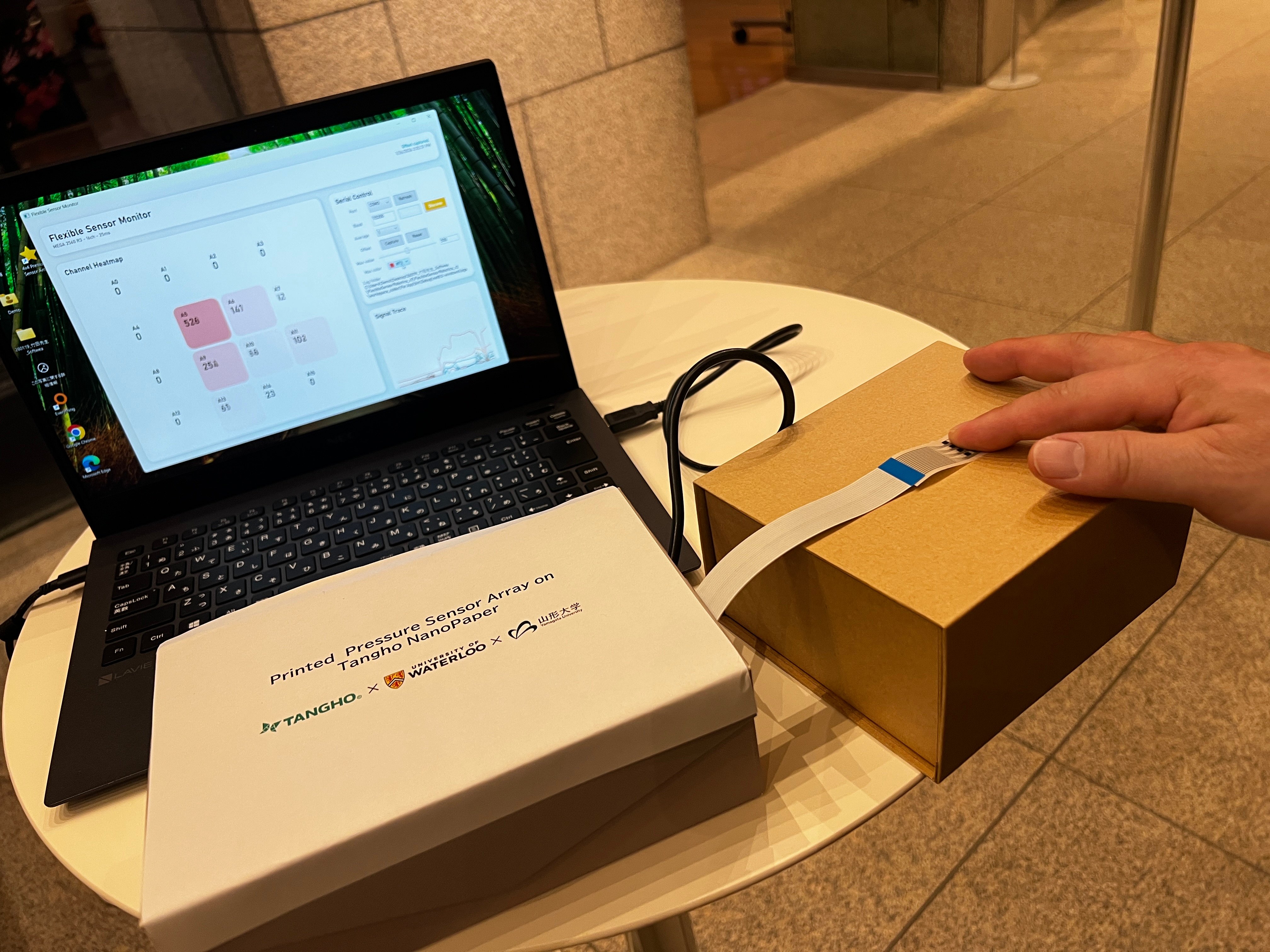

Developed through a collaboration between Yamagata University, Tangho Green Canada Inc. and the University of Waterloo, the 4×4 pressure-sensor demonstrator shows Tangho NanoPaper™ supporting a working printed sensing device. Presented at nano tech 2026 in Tokyo, it connects materials development with something visitors can see and interact with directly.
The collaboration brings together the printed-electronics expertise of Professor Ayako Yoshida and her colleagues at Yamagata University’s Innovation Center for Organic Electronics (INOEL), with NanoPaper substrate development from Tangho and the University of Waterloo. Professor Yoshida leads INOEL’s Sustainable Hybrid Electronics group, whose work includes printing processes and flexible sensors.

How the pressure-sensor array works
The demonstrator contains sixteen sensing positions arranged in a 4×4 grid. Printed silver electrodes provide the electrical connections, while a carbon-based ink forms the pressure-sensitive layer.
When pressure is applied, the electrical resistance of the sensing construction changes. A microcontroller reads the signals and sends them to a laptop over USB, where they appear as a two-dimensional map. Pressing different locations produces a changing response across the array.
This is the basic idea behind a printed “electronic skin”: a thin sensing surface that translates physical contact into an electrical signal. The response depends on the complete device, including the sensing material, electrode arrangement, connections and readout electronics.
Building the sensor through printing
The electrode-printing work used nanoparticle silver ink deposited onto NanoPaper by screen printing, followed by oven treatment. A carbon-based sensing ink provided the pressure-responsive material.
Selected materials and processing conditions used in the development work are summarised below.
| Material or process parameter | Description |
|---|---|
| Substrate | Tangho NanoPaper nanocellulose film |
| Conductive ink | Nanoparticle silver ink |
| Sensing ink | Carbon-based ink |
| Electrode-printing method | Screen printing |
| Squeegee speed | 50 mm/s |
| Squeegee angle | 70° |
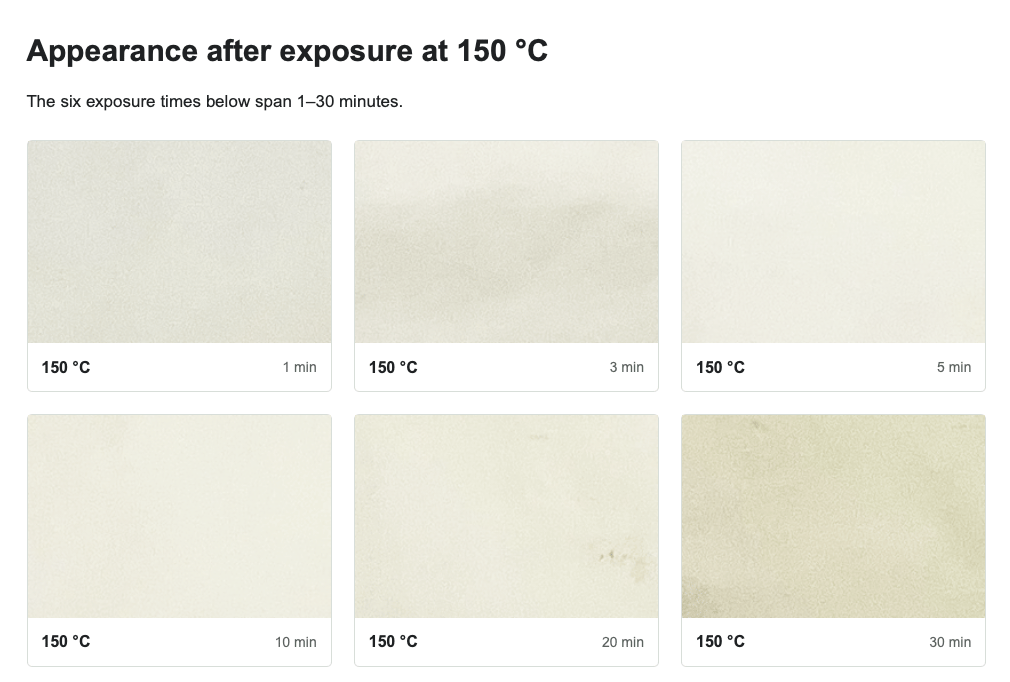
| Electrode oven treatment | 130 °C for 30 minutes |
For a printed device, successful fabrication involves more than depositing a conductive pattern. The substrate must work with the printing and drying steps, while the printed layers and electrical connections must function together in the assembled sensor. This demonstration brings those elements together in a device with a visible response to touch.
Why use NanoPaper?
NanoPaper is a flexible film made from cellulose nanofibres. For printed-electronics developers, its value lies in the opportunity to evaluate a cellulose-based substrate within familiar fabrication workflows.
The pressure-sensor project provides a concrete example: printed electrical connections and a functional sensing layer were integrated on NanoPaper and connected to conventional readout electronics. That gives development teams a practical starting point for exploring how the material could fit their own devices.
The renewable origin of cellulose adds another reason to investigate this approach. Environmental performance, however, depends on the complete device—including its inks, components and end-of-life route. Substrate selection is one part of that design process.
From a demonstration to an application
A working pressure map opens up useful development questions. How large should the sensing area be? What loads must it detect? How closely spaced should the sensing positions be? What happens after repeated loading, bending or changes in humidity?
Potential directions include touch interfaces, contact sensing for robotics and pressure-responsive surfaces. Each requires its own performance targets and evaluation. Sensitivity, hysteresis, repeatability and load cycling are useful starting points, alongside the durability of the connections and readout assembly.
The displayed map shows the changing sensor response. Turning that response into quantitative pressure measurements requires calibration under defined loading conditions.
For teams developing printed sensors, the demonstration offers a tangible starting point for evaluating NanoPaper in a complete device.
Explore our screen-printing guidance and technical data sheets, or discuss your application with Tangho. Share a short, non-confidential description of what you are developing so we can help define a focused material evaluation.